
Months had softened the unfamiliar into routine. Life was still heavy in the ways that mattered — in the measured grain, in the medicine counted drop by drop — yet it had grown gentler around the edges. Their house no longer echoed with emptiness; it held voices, movement, the small, ordinary sounds that make a place one’s own.
Her brother now left every afternoon to play and returned at dusk with scraped knees and laughter instead of silence and shame. Watching him, Kusum often felt as though the road they had taken had not led them away from something, but toward a second beginning — a life that asked them to stand, and perhaps, in time, to rise.
Sitting beside the chulha, Kusum frowned at the little flour that remained in the tin. She let out a slow breath, already knowing what it meant — tonight she would sleep on an empty stomach again. There was some rice left, enough to cook a proper meal, but she closed the lid and pushed the container back into its corner. Morning came with its own hunger, and she could not afford to spend it in the dark of night.
Choosing to make the dough from what little remained, Kusum began rolling the chapatis. She was midway through pressing one between her palms when her mother’s violent cough tore through the room. Startled, she quickly pushed the burning wood deeper into the chulha to lower the flame and hurried to her side.
“Amma, paani pee le.” (Amma, drink some water.)
She lifted the glass she had brought along and held it to her mother’s lips.
“Tune phir dawai nahi khai na?” (You didn’t take your medicine again, did you?) she added, a faint sternness in her voice as she turned toward the small wooden box that held the medicines.
The tonic bottle was empty.
“Arey, woh khatam ho gayi thi,” (Oh, it had finished.) her mother said softly from behind her. “Aur waise bhi mujhe itni koi khaansi nahi hai, kya hi zaroorat hai dawaiyon ki.” (Besides, my cough isn’t that bad. What need is there for medicines?)
Another violent spasm of coughing cut her words short. Kusum abandoned the box at once and clasped her mother’s hand, her worry tightening into silence.
“Haan haan, tujhe toh bilkul zaroorat nahi hai dawai ki,” (Yes, of course, you don’t need medicine at all.) she replied with quiet sarcasm, gently patting her back until the coughing subsided.
When her mother’s breathing finally steadied, Kusum picked up the empty bottle, poured a little water into it, shook it to gather the last traces of the tonic, and held it out.
“Pee lo.” (Drink it.)
Her mother obeyed without protest.
Kusum set the bottle aside and wiped her hands on the edge of her sari.
“Mere paas hain kuch paise… main dawai lekar aati hoon.” (I have some money… I’ll go get the medicine.)
Kusum stepped out before anyone could stop her.
The night had settled gently over the village, the kind that did not bring fear but a deep, listening silence. A few houses still had their lamps burning; from somewhere far off came the faint clang of a temple bell, followed by the barking of a dog that seemed too tired to continue. Pulling the end of her dupatta closer around her shoulders, she walked quickly through the narrow lane, her fingers curled tightly around the small knot of coins.
She did not need to open it to know how much was inside.
Those were not medicine coins.
Those were the coins she had been saving for months — a paisa at a time, sometimes by eating less, sometimes by walking instead of taking the cart — for her younger brother’s clothes. The image rose before her eyes without effort: his kurta stretched tight at the shoulders, the sleeves ending awkwardly above his wrists, the carefully stitched patch at the knee that had begun to tear again. He never complained, only tugged at it absentmindedly when he thought no one was looking.
Her steps slowed for a moment.
Next month, she told herself. I will stitch something for him next month.
The thought did not comfort her.
The market lay near the main road, still half awake even at that hour. Two lanterns hung from the grocer’s shop, their light trembling in the warm air. The smell of roasted peanuts and stale jaggery lingered, mixed with the sharp scent of kerosene. A couple of men sat on an upturned crate discussing crop prices in low voices, and the vaid’s small shop at the corner was just in the act of closing.
“Baba… zara ruk jaiye.” (Please wait a moment.)
The old man looked up as she approached, recognition dawning slowly.
“Dawai chahiye?” (You need medicine?)
Kusum nodded, placing the coins on the wooden counter.
“Amma ki khaansi ke liye wahi wali.” (The same one for my mother’s cough.)
He uncorked a bottle, measured the tonic carefully, and poured it into a small glass vial. Kusum watched every drop, calculating without meaning to — how many days it would last, how long before it would finish again.
“Raat ko zyada khansi badh jaati hai?” (Does the cough worsen at night?) he asked casually.
“Haan.” (Yes.)
She took the bottle from him with both hands, as though it were something fragile enough to break hope if held carelessly.
On her way back the village seemed quieter. The men had left, the grocer’s lantern dimmed, and the road belonged only to the sound of her own footsteps.
I will have to work.
The thought came not as a wish but as a decision.
Until now she had stayed within the rhythm of the house — cooking, cleaning, tending to her mother, stretching her father’s earnings into meals that lasted. But that was no longer enough. Medicines would return. Grain would finish. Her brother would grow.
She could sew. She could grind grain. She could work in someone’s field during harvest. There had to be something.
For the first time since coming to the village, the future did not appear as a stretch of careful survival but as something that demanded her step forward.
When she reached home, the chulha had died down to a soft red glow.
Her father looked up from where he sat near the door, as though he had been listening for her footsteps all along. His eyes went first to her face and then to the bottle in her hand. He did not ask where the money had come from.
“Khaansi thodi kam hui?” (Has the cough eased?) he asked quietly.
“Haan,” she replied. (Yes.)
Inside, her mother was lying down, her breathing still uneven but calmer.
Kusum poured the tonic into the spoon and held it to her lips.
“Dheere se.” (Slowly.)
Her brother slept beside the wall, one arm flung over his face, his worn sleeve pulled halfway to his elbow.
Kusum watched him for a long moment.
Then she rose, went back to the chulha, and placed the rolled chapatis on the warm iron plate.
She would eat in the morning.
Tonight, it was enough that her mother had the medicine.
And somewhere deep inside her, a decision had taken root — small, quiet, and unshakeable — that the next time money left her hands, it would not be the last of something saved in secret, but the first of something she had earned herself.
__________________
__________________________
Morning in the village did not begin at the temple.
It began at the haveli.
Before the first proper light spread across the fields, its outer courtyard was already awake — lanterns being put out one by one, the clang of metal buckets at the well, the low murmur of men waiting with ledgers tucked beneath their arms. The great wooden gates stood open, not in invitation but in habit, as though they had never known a day when someone was not entering or leaving under its arch.
From the terrace, the land could be seen in long, obedient stretches — wheat ready for harvest in one direction, freshly turned soil in another, the narrow silver line of the canal dividing it with careful precision. Every field had a boundary. Every boundary had a name. And every name was written in the same set of books that lay each morning on the long table in the outer hall.
By the time the sun rose fully, the courtyard had filled.
Tenant farmers stood with their turbans in their hands, shifting their weight from one foot to the other, speaking only when spoken to.
A merchant from the grain market opened his cloth bundle and placed a neat stack of coins on the table before bowing slightly — not in servility, but in acknowledgment of an order older than both of them.
Two men from the neighbouring village waited near the steps, their dispute reduced to silence in the presence of a place where decisions were not argued, only given.
Inside, clerks moved steadily — dipping reed pens into ink, calling out figures, turning pages that carried years of harvest and drought and settlement.
Nothing was loud.
Authority did not need volume there.
When he stepped into the outer hall, conversation did not stop — it lowered.
Not a single person turned fully toward him, yet every posture changed.
Thakur Veerendra Singh did not walk quickly. He never had.
His presence travelled ahead of him — in the straightening of shoulders, in the way a man who had been speaking too freely now chose his words, in the clerk who checked his numbers twice before reading them aloud.
He listened more than he spoke.
A question about yield in the eastern fields.
A brief instruction regarding the repair of the canal embankment.
A single glance at the merchant’s account that made the man reopen his bundle and add two more coins without being asked.
It was not fear that governed the space.
It was certainty.
It was near noon, while the next ledger was being placed before him, that the patwari said in an almost conversational tone,
“Gaon mein suna hai… us ghar ki ladki kaam dhoondh rahi hai.”(It is being said in the village… the girl from that house is looking for work.)
The Thakur did not look up immediately.
He finished reading the line before him, closed the ledger, and only then lifted his gaze.
“Kaam?”
(Work?)
“Ji. Baap roz-marra ki mazdoori par jaata hai… ladki ghar sambhalti hai. Ab shayad bahar ka bhi kuch dekh rahi hai.”
(Yes. The father works as a daily labourer… the girl runs the house. Now it seems she is looking for something outside as well.)
A pause — brief, measured.
“Hmm.”
The matter ended there for everyone else.
The accounts continued. The figures were called. The ledgers turned.
Yet the information had reached where such things were meant to reach.
By midmorning the courtyard had emptied into the land.
In the fields, the harvest had begun. Women bent in long rows, their sickles moving in the same rhythm, the cut wheat gathered into neat bundles. A supervisor walked between them, calling out instructions that carried the authority of the haveli even though the Thakur himself was not there.
Bullock carts moved slowly along the mud track, heavy with grain.
At the threshing ground, dust rose in golden clouds, settling on skin and cloth and hair until everyone looked like they belonged to the earth they worked on.
The grain merchants would come by afternoon.
They always did.
They would sit in the outer hall, speak of market rates in careful tones, and leave behind the agreed share before taking their carts onward.
This was how the village breathed.
Through land, through labour, through accounts that balanced not just profit but power.
Later, when he rode out to inspect the western boundary and the path curved past the southern lane, his horse slowed of its own accord near the house where fresh cow-dung had been spread in a neat circle before the door and a row of washed utensils caught the sun.
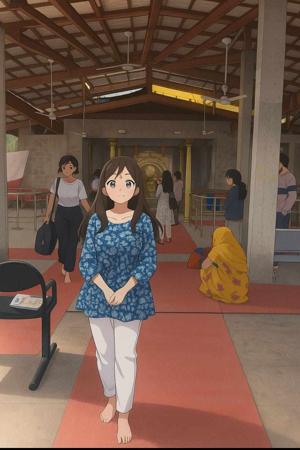
A girl was kneeling near the chulha in the courtyard, her dupatta pulled forward to shield her face from the smoke, her movements swift and economical.
The posture of someone who had been doing it for so long.
He did not stop.
He did not turn his head fully.
Yet he knew — with the same unerring awareness with which he knew the condition of his fields — the order of that house, the discipline in its small details.
He rode on.
But somewhere within the day’s careful accounting, a new entry had been made.
Not important.
Not urgent.
Simply noted.

Write a comment ...